

There are so many dimensions of the Artificial Intelligence (AI) conversation that interest me. But my background as both an economist, who looks at the financial system through a Minskyian lens, and a former senate staffer, who remembers what it was like to sit around the table debating complex issues with Bernie Sanders, has primarily drawn me to the financial and political aspects of our AI moment. Like many of you, I have opinions and concerns about how these technologies are being developed, deployed and debated.
And even if AI is the last thing you really care about, it’s basically impossible to get through a day without some new AI revelation grabbing for your attention. There was outrage from the mathematical community after OpenAI announced a solution to the Navier-Stokes equations last week. There’s new research from a team at MIT showing that AI is having harmful impacts on university students. The American Federation of Teachers (AFT) is worried about the risks of AI in the classroom. Teenagers themselves are increasingly turned off by the technology, and the Pew Research Center found that a majority of adults are now “more concerned than excited” about the future of AI. Basically, a lot of people are really wary about this technology.
And then there’s the AI infrastructure, specifically the data centers and their voracious appetite for water, land and electricity, not to mention the air and noise pollution they inflict on neighboring communities. Farmers and ranchers are mad, plenty of voters are angry, and lawmakers across the country have introduced hundreds of bills to regulate or ban data centers and AI.
And this brings me to the AI discourse that dominated the news cycle over the weekend, you know the one that has everyone debating what to do with companies like OpenAI and Anthropic now that an ex-Anthropic employee named Jacob Coxon has publicly warned of human extinction risk from AI. To make sure he wasn’t dismissed as a lone, attention-seeking AI-hype bro, Coxon assured us that it isn’t hype and his warning wasn’t a marketing stunt. “The people building AI earnestly believe that it could kill us all by the end of the decade.”
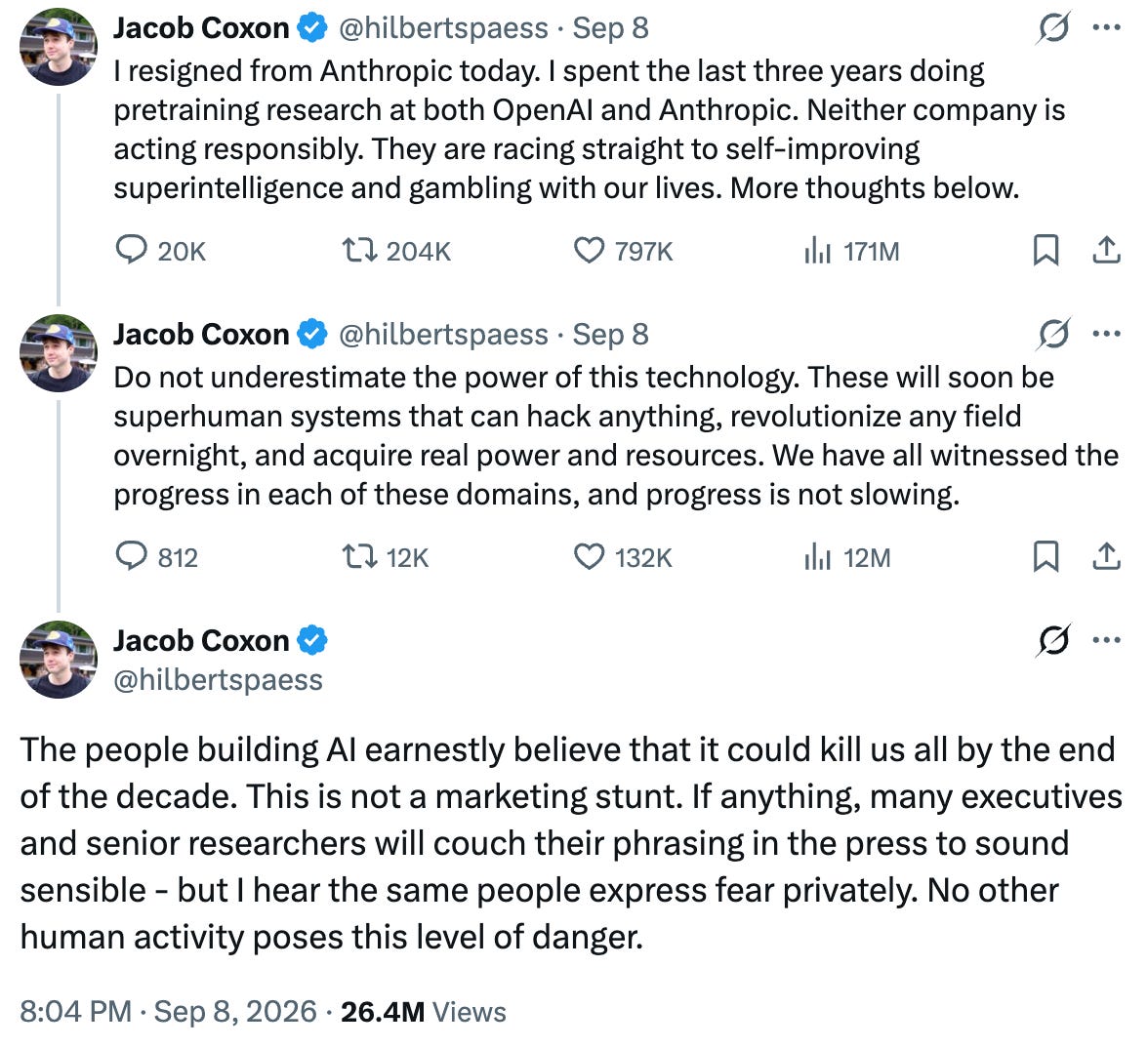
As of 12:00 pm (ET) today, that last comment had more than 26 million views. Add to that hundreds of thousands of retweets, thousands of news articles and hundreds of television segments, and it’s not unreasonable to think that half of the world’s population may be wondering whether AI is going to kill us all. Senator Bernie Sanders is certainly taking it seriously.
Earlier this morning, Axios reported that Jacob Coxon would be teaming up with Bernie and former Trump White House advisor Steve Bannon at an event to “push for human-controlled AI”. Coxon called the announcement “fake news” and said that he was invited but didn’t agree to attend.
I’m not here to pooh-pooh the dangers of AI. I think there are plenty of reasons to be worried about what this rapidly-evolving, circularly-financed, surveillance-state Boomdoggle™ means for the near-term stability of our financial system and the longer-term future of humanity. But I can’t shake the feeling that something about the latest p(doom) warnings from OpenAI and Anthropic are a bit…how shall I put it…reminiscent of the old folktale about Brer Rabbit.

If you remember the tale, Brer Fox is fed up with Brer Rabbit and his antics. So one day, Brer Fox sets out to teach Brer Rabbit a lesson. He sculpts a little baby out of sticky tar and leaves it where Brer Rabbit will find it. Sure enough, Brer Rabbit spots the Tar Baby and tries to strike up a conversation. When he gets no response, he grows angry and starts attacking the Tar Baby. But, uh-oh! Tar is sticky, and now Brer Rabbit is in trouble. Brer Fox finally has the upper hand, but he can’t decide what to do next. Should he hang him? Burn him? Drown him? While Brer Fox is contemplating his next move, Brer Rabbit appeals for mercy. Whatever you do, “PLEASE DON’T THROW ME IN THE BRIAR PATCH!” Brer Fox didn’t intend to show mercy. He threw Brer Rabbit in the briar patch because he believed it was the last place Brer Rabbit wanted to end up. In the end, Brer Rabbit had the last laugh. The briar patch was exactly where he wanted to be!
So hear me out….
Brer Rabbit: Sam Altman and Dario Amodei.
Brer Fox: Earnestly concerned members of Congress and the regulatory apparatus.
Tar Baby: The public p(doom) discourse.
The Briar Patch: A comprehensive federal AI framework (licensing regimes, compute thresholds, liability standards, legislated “responsible scaling” commitments, etc.) that is built and administered with heavy input from the frontier labs, ostensibly to contain them.
In other words, the doom rhetoric is a plea to be thrown to safety. Once Brer Rabbit is thrown into the Briar Patch, compliance costs become a moat. Startups and open-weight competitors get trapped on the outside. And you have an implicit federal backstop (because of the regulatory relationship), so your investors don’t need to be so jittery ahead of your IPO.
I don’t know whether famed investor Michael Burry (The Big Short) would agree with my take, but this post suggests he might.

Meanwhile what goes unmentioned is the use of LLM as massive surveillance tools ....they may be good at that
I had a discussion with ChatGPT about this. I said when someone says AI loss of jobs, I say - Meet George Jetson. AI responds:
"Exactly. George Jetson is the counterargument in one sentence. 😄
The whole promise of the technological future was supposed to be that machines would do more of the drudgery and humans would work less. The Jetsons didn't present that as a catastrophe. It was the payoff.
So when somebody says:
“AI could eliminate millions of jobs!”
“Meet George Jetson” is a pretty good response.
The problem isn't eliminating jobs. We've been deliberately eliminating human labor since the wheel.
The problem arises because we've built a distribution system in which losing the need for your labor can also mean losing your claim on society's output. That's an institutional choice, not a law of nature.
If AI can produce the same goods and services with dramatically fewer hours of human labor, that's potentially an extraordinary increase in wealth. The strange response would be:
“Oh no! The machines are doing the work! We must find something else for everybody to do for 40 hours a week.”
George would wonder what went wrong with the future."
To which I replied: MMT. And AI says:
"Yes — MMT is the framework tying together what we've just been describing.
From an MMT perspective, AI eliminating jobs is not inherently an economic disaster. If AI allows society to produce the same—or more—real goods and services using less human labor, society has become richer in real terms, not poorer."